Favourite titles

Favourite titles
Whether it is "Redefining literary techniques and devices", "Justifying Papua New Guinea Literature", or "Translating the Bible into Anuki", these offer valuable reading for the paperless student of literature, and indeed the best sort of literary entertainment you can get out of Papua New Guinea. Check them out either on Soaba's Storyboard or The Anuki Country Press.

Thursday, 7 March 2013

SPARTANS OF PNG LITERATURE

Ms Joyce Pogla, course advisor of the Literature and English Communication Strand, signing on new students for the 2013 academic year.
                                                                                 
The number of fresh intake of literature and English communication students at the University of Papua New Guinea has fallen to the lowest since the 1980s. This was noted at the start of this year’s academic year when the university’s School of Humanities and Social Sciences met to welcome its new students in its orientation program.

There may have been a lot more candidates wishing to apply but these might not have done so due to various complications encountered at their respective schools throughout the country.

Nonetheless, the Executive Dean of the School of Humanities and Social Sciences, Professor Betty Lovai, said a few good things to these new students and many would appreciate her words of wisdom.

Their new life for four years at the university, the Dean had pointed out then, would prove all the more testing. They were at a place away from home and parents, she further stressed, to become mature adults in scholarship and learning. It meant reading as much as they could not so much to digest books as books or literature as literature, as to become critical thinkers themselves. Their expertise, their diligence in scholarship and learning was what was needed to make Papua New Guinea adjust itself to the fast changing times that we live in.

An hour after the Dean’s address students of various strands within the School of Humanities and Social Sciences took leave for much more informal meetings with their lecturers and tutors. It was then that the literature and English communication staff as a strand discovered they had only seven new students present there for them to meet.

At first they were shocked. The staff outnumbered their students by more than half, it seemed.

And yet this is the largest strand within the School of Humanities and Social Sciences boasting, economically speaking that is, of managing more than a thousand students in its compulsory courses. Students from virtually all of the schools of the university come to do these compulsory courses as a necessary requirement to graduate at all after four years of study.  And this year the selectors would only provide the strand with seven new students?

Over the next few weeks, however, it was discovered that literature and English, as a strand, had in fact seven non-school leavers, approximately fifteen continuing students and seventeen school leavers as its fresh intake. That balanced things out a bit, as it were.

But that should not mean the strand may now recoil to its comfort zone of the sublime and beautiful in scholarship as the issue at heart of our article here is to point in the direction of how much this strand has been ignored over the years.

To start off with, the strand has been denied a strand leader over the Christmas-New Year break. Financially speaking that would be a crucial oversight on the part of the strand’s superiors as administrators. It does not matter what measures are taken in these cost-saving exercises, so-called, as the intriguing factor noted here was that a whole strand lacked any sense of leadership at a time when all decisions pertaining to finance and expenditure across the board would mean denying that very strand any participation at all in that process of decision making.

The outcome to this was simple. For every staff member of the strand returning to duty, it became a norm and the usual knowledge that the whole school was broke, there was no money left for purchases of new equipment and staff were thus required to buy their own computers and stationery to teach at all.

The second denial noted was that none of the staff of the Literature and English Communication Strand was required to teach any of the strand’s external courses during Lahara (October 2012 to January 2013). The argument? Too much money goes to Literature and English. Let’s give the other strands a chance.

It might not be surprising to hear next that the strand itself might be shelved in preference to other service-oriented strands, whatever that may be. This is by no means an act of disrespect to the superiors by pointing out these little details here, but it strikes one as odd that Literature and English, the largest of strands within the School of Humanities and Social Sciences, would be singled out as something of an unnecessary flaw within the consciousness of a premier institution of higher learning such as UPNG.

While the number of its student population dwindles away to less than those of the 1980s the strand still retains its status as the provider of the sort of learning proved wiser in so many respects, starting from the country’s pre-Independence era. That every student that comes out of this strand does something extraordinary often in favour of humanity out there, in the free wide world.

A quick look at class distributions of students doing literature this semester reveals the following: 17 in Literary Criticism, considered the strand’s most boring course coordinated by Storyboard himself; 11 in Literature, Nation and Culture, also a Storyboard course; 57 in Literature and Politics coordinated by Dr Steven Winduo; and 3 in Special Topics of Storyboard’s and members of staff.

The strand considers Literature and Politics its heart beat that makes the university itself tick as the premier institution of higher learning within the Pacific region. In bringing a review of the course text book of this course called “Transitions and Transformations: Literature, Politics and Culture in Papua New Guinea” to appear on these pages shortly perhaps the reader will that way be given the opportunity of knowing how vital Literature and English Communication is in UPNG.

This year the strand has approximately 39 majors on record. It depends on how that number performs during the course of the four-year BA in Literature and English Communication program. The number may be less come graduation day. But even that small number should suffice in churning out what should rightly be considered the Spartans of PNG Literature.  
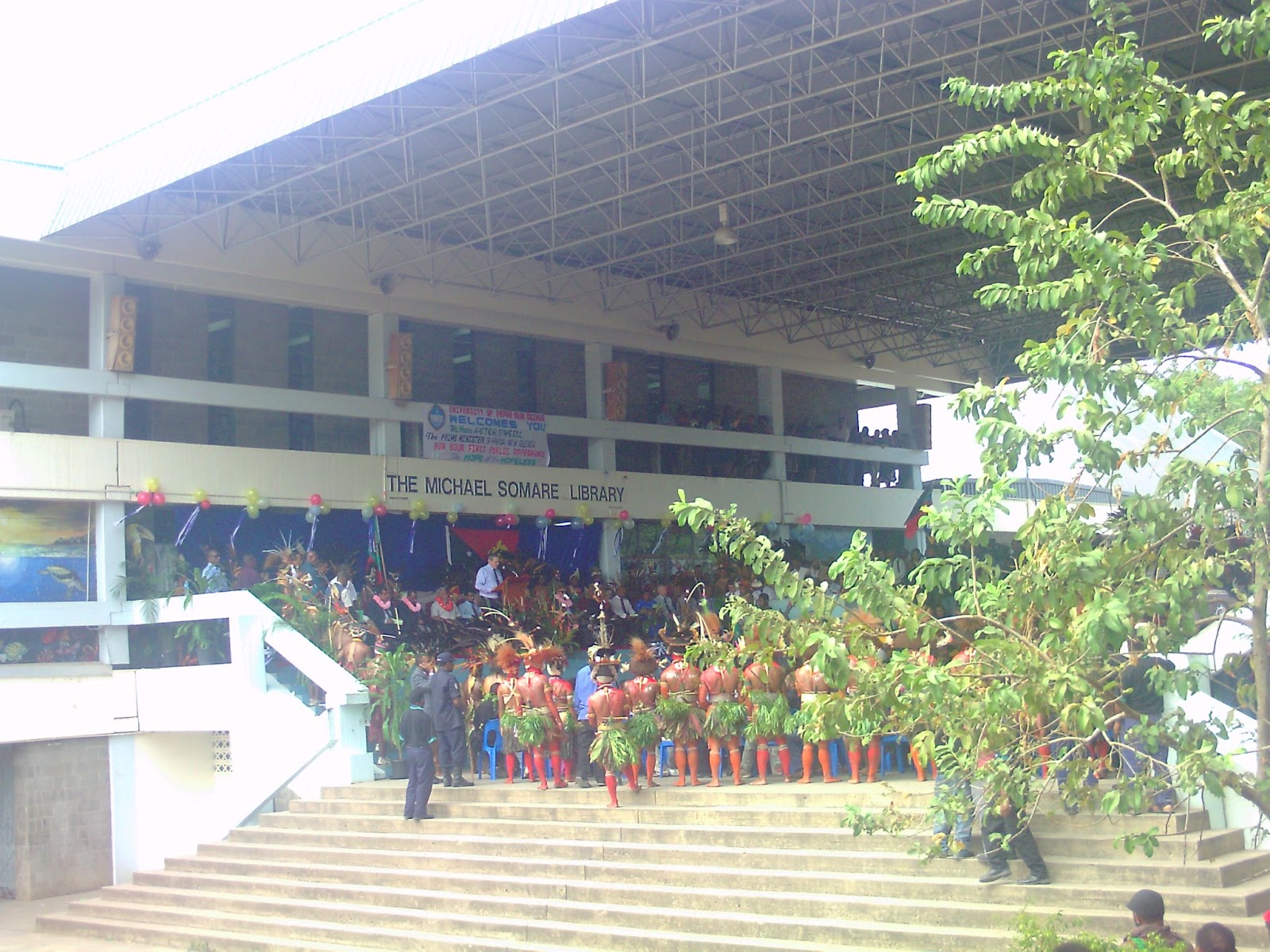
                                                                                                                      

Sunday, 25 November 2012

SYMPOSIUM ON CULTURE AND ARTS


Photo by Ketsin Robert.
                                                                       
The National Cultural Commission has once again come to easing and soothing the woes of struggling Papua New Guinean writers, artists and musicians through the staging of its National Symposium on Culture and the Arts.


This was observed at the National Museum from 7th to 9th November, 2012, and in collaboration with the National Museum, the Melanesian Institute of Art and Culture, UNESCO, UOG and various institutional and private bodies in town.

Among the highlights of this event was the launching of the locally-made University of Goroka film “The Last Real Man” by the Minister of Culture and Tourism, Honourable Boka Kondra.

The main theme of the symposium was “harnessing the arts for national development”. Papers presented were therefore of a variety of subject matter, not wandering too far off from the theme, of course, although there were one or two powerful oratories of some value during the course of the whole program.

Themes covered at this three-day long symposium included the importance of culture and the arts in nation building, cultural industries and the challenges facing these, the actual development of cultural and creative industries, problems of copyright, promotion and marketing, capacity building, heritage and the cultural industries, views representing provincial perspectives and, finally, the work of the writers and artists themselves.

Many thought that the last session, appropriately titled “artists’ corner”, which was devoted to writers, artists, musicians and film makers and headed by this writer, was the fiery one of the lot. We’ve heard the best of oratories then. Nonetheless the whole program was seriously observed and with many new things learnt within the world of arts and letters.

An interesting detail noted during the week was that of Professor John Waiko’s assertion and insistence upon the fact that while we still believe we have 800 languages there are, in fact, 1,100 plus pure languages in Papua New Guinea today, with a few others yet to be discovered. But, warned the professor, on yet another matter of relevance, if we do believe that we have that number of languages in our country we must also provide material evidence as scholars do throughout the world that we have been here on our island nation for the last 50,000 years. 

Dr Steven Winduo speaking on the importance of arts and culture in nation building pointed out that there had been so much dug out of our country by way of cultural research and knowledge with very little given back in return. And yet these are crucial elements constituting our sense of culture, nationalism and cultural inheritance or identity.

 Another speaker on this topic, Mari Ellingson, spoke of music as a significant aspect of our lives, touching as well on the problems of copyright and pirating of local musical products or in simply dealing with the industry itself in a manner that often brought little reward to the musician as an artist. “Music comes from the heart,” said Ms Ellingson, “the spirit, the soul.” Just as any other cultural unit it, too, needed support, especially in funding. Examples cited, among others, was the lack of facilities found at UPNG to cater for both staff and students of that institution.

Aside from the intellectual debates and discussions that went on there were poetry readings and music provided in the evenings, culminating each day's proceedings. It was fun kind of a symposium, thanks to Dr Jacob Simet and his staff at NCC and to Dr Andrew Moutu for providing the venue and necessary facilities for the whole program.

But, as it is often said of them, “Where there are writers and artists there is much merriment and feasting.”

Thursday, 1 November 2012

TIRED OF THE CITY

                                                                           
 Time to flee the overpopulated crowds of Port Moresby city and go home.


And why not?

Go home, meet up with cousins and forget the night mares of the city, say the children.


And why not?

HAPPY HOLIDAYS, ONE AND ALL!


Thursday, 25 October 2012

THE LITERATURE OF HIGHER LAWS

                                                                      
No one feels and knows the impact of good literature until he or she experiences it first hand.

When we read Alice Wedega we think we are reading stuff that is conservative, out-dated, irrelevant. But the teachings of this great woman remain as powerfully contemporaneous as ever. When she says, for example, that for a Milne Bay woman the choice is either to serve God or marry, she ain't kidding.

There are no in-betweens.  The in-betweens usually spell disaster. Those that are descendants of this great writer must therefore be extremely careful how they conduct themselves and the life style they choose to lead. You either are married or are serving God.

In a Sophoclean drama things are much more tragic than that. Antigone, following the rules of those higher laws, marches forward to meet her fate. In a Shakespearean tragedy it is wise to take heed of the lessons imparted in a young general who calls his would be followers "curs", or a mighty general misled into thinking that his young bride is unfaithful.

And so with us in our country. And how we regard literature.

For those who study literature know that as far as the laws are concerned you are the invisible legislators, your are the unofficial ombudsmen of your society. The literature you create remains as powerful as Shakespeare had willed it in composing Coriolanus or Othello.

And so the message left by Alice Wedega remains as powerful as ever. Listen, and you will never go wrong.


Wednesday, 10 October 2012

TALKING ABOUT MY PORT MORESBY


O friend
O fellow mariner
How can I ever forget you?
At 16 I sailed into your harbour
tired, hungry, lost somewhat
yet fascinated when I woke up the next day
from the Koki Mission Station
to look upon your stilled waters again
your ever enduring beauty.

There and then did I first

set my sight upon you
my eternal lover

I will never forget you

I will never abandon you
my Port Moresby!

                                    
I first set my foot on Port Moresby's soil at 16. The township then was the most beautiful in the Territory. There were no such places as Tokarara, Gerehu, Waigani, Erima or Morata. These were bush, the hunting grounds of the Motu/Koitabus. 

In fact, as recently as the 70s we could see some maganis come out at dawn, lick their paws before the morning sun and start chomping away at the lawn that surrounded the Waigani campus. That is how fresh and hygienic Port Moresby was then.

Today, the whole city is so overridden with trash and filth not a single one of our so-called "social engineers" knows how to clean the mess up. Sad... so sad.

                                        
This post is dedicated to Gerard Dogimab and Michael Midiwabu.                

Friday, 5 October 2012

NIGHTFALL

                                                                           
 A poem by Naka Tauna

Darkness steals across the sky
An explosion of colours on the horizon
Lit fires dot the island, mothers hush children
Aroma of smoked fish mingled with coconut milk
Smoke spirals endlessly towards the heavens
A musician’s tune drifts slowly on the breeze
Scent of jasmine and frangipani saturates the air

                                                                      
A lone fisherman pulls up his catch
Creatures of the night stir and fly hither
Echoes of distant thunder

                                                                             
Swaying palm trees whisper softly to the wind
Rain comes falling
A moist blanket encompassing all
The stillness of the night is drowned
Cool southerlies calm the storm
Billowing clouds disintegrate like vapour
A slight breeze settles the windswept beach

                                                                                  
The silence is captivating
A silver sphere rises majestically
Covering the sky in abundant light
An eerie glow illuminates the earth
Shards of light spill softly thru thatched roofs
Filtering thru windows, toying with dark shadows
Playing havoc with one’s imagination
Cicadas and crickets lead the crescendo
Fireflies resemble floating fairy lights

                                                                             
Night fishermen gather quietly
Waves lap gently, canoes side by side
Paddles slice thru water
Following a shimmering path
Ghostly apparitions disappearing into the mist
A lone owl hoots overhead
Black figures materialize out of the shadows
Silhouettes of women drift endlessly
Onward towards a secret destination
Children slumber with dreams of a new day